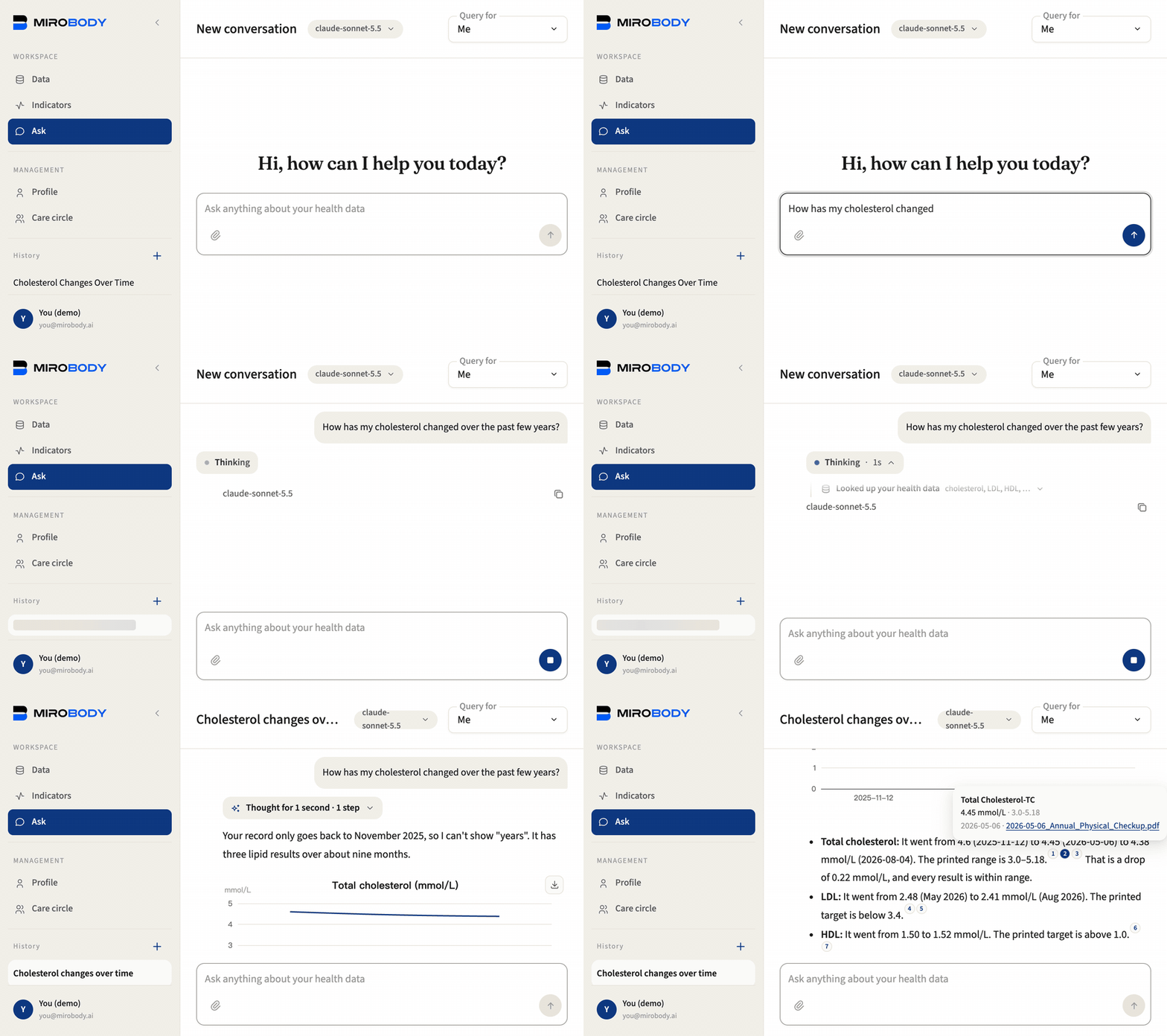
What is Mirobody?
Mirobody is an open-source, self-hosted health-data + AI engine — a lightweight C++ core that links your personal health data to LLMs and runs anywhere: standalone on a server, or on-device inside the Android / iOS apps so your data never has to leave the phone.- 🧩 One core, three forms — a single C++ engine ships as a standalone binary (HTTP + WebSocket), as a shared library inside the mobile host apps (JNI on Android, a C API on iOS), and via a plain
extern "C"surface that any language can embed. - 🔌 MCP server — built-in tools are exposed over a Model Context Protocol endpoint, callable by ChatGPT, Claude, Cursor, or any MCP client.
- 🤖 Multi-provider chat — one streaming interface over OpenAI, Google Gemini, and MiroThinker, plus a fully on-device option (Gemma via LiteRT-LM / llama.cpp) so chat can run with no server and no network.
- 🔄 Health-data connectors — wearables, phone health stores, and clinical EHRs (via SMART on FHIR) flow in through pluggable vendor clients; on-device stores (Apple Health, Health Connect) are read by the host apps.
- 🏥 FHIR R4 native — an embedded FHIR R4 endpoint normalizes everything (units to UCUM; indicators mapped toward SNOMED CT / LOINC / RxNorm) and serves it back as FHIR resources.
This docs site covers Mirobody’s health vertical — the engine behind Theta Wellness.
Quick Start
Build the C++ core and run it in minutes
Use Cases & Examples
Real conversations with synthetic health data
Provider Integration
Add a new device or data source in hours
Managed API Platform
Prefer a hosted API over self-hosting? Same engine, managed for you.
Why Mirobody?
Your data stays yours
The core runs locally end-to-end. On desktop / server it’s a single binary over your own Postgres (or SQLite); on phones the same core runs on-device, so health data never has to leave the device unless you choose to sync it. Bring your own LLM key (OpenAI, Gemini, MiroThinker) — or run fully offline with on-device Gemma.
One core, runs anywhere
A single C++ engine with a plain
extern "C" C API. It ships as a standalone HTTP / WebSocket binary, as a shared library inside the Android / iOS host apps, and is embeddable from Java, Go, C#, Rust, Swift, or Python via that C ABI — no per-platform rewrite.A lightweight, tool-using agent
A lightweight, tool-using agent
One agent: it picks an LLM client by provider name, builds the system prompt, and streams the turn back — calling built-in MCP tools (read files, render charts, family health, memory) as needed.
MCP tools, compiled in
Tools are C++ files in
res/mcp_tools/ that self-register at compile time — drop a .cpp with the MIROBODY_REGISTER_TOOL macro and rebuild. They’re exposed over the /mcp endpoint for ChatGPT / Claude / Cursor and run in-process for the built-in agent.Files, parsed into health data
Files, parsed into health data
PDFs (PDFium), Excel / CSV (xlnt), and images (OCR via Tesseract, plus vision-model inlining) are parsed; values are normalized (UCUM) and written to the embedded FHIR store.
Voice & realtime
Voice & realtime
Realtime audio chat over WebSocket via OpenAI Realtime and Google Gemini Live.
Care circles
Care circles
Create a circle and invite people by email; members can share a conversation (view / edit) or their health data (per-person, off by default). The agent can then answer “how is my family doing?” reading only what members chose to share.
Architecture at a glance
Five pieces make up the core (all C++):| Piece | Path | Notes |
|---|---|---|
| LLM clients | src/llm/ | One streaming client per provider — OpenAI, Google Gemini, MiroThinker, on-device Gemma (LiteRT-LM / llama.cpp), plus Realtime / Live audio |
| MCP tools | src/mcp/ + res/mcp_tools/ | Server-side tools over a Model Context Protocol endpoint |
| Agent | src/chat/ + res/agents/ | Picks a client by provider, builds the prompt, streams the turn |
| Health vendors | src/health/vendor/ | Wearables, phone stores, and EHRs (SMART on FHIR) behind one authorize / fetch / webhook contract |
| FHIR R4 | src/fhir/ | Embedded FHIR endpoint + terminology (UCUM; SNOMED CT / LOINC / RxNorm) |
.cpp in the matching res/ directory and rebuild.
Data sources
Health data flows in through pluggable vendor clients, in four buckets:Aggregator platforms
Terra, Validic, Human API, Junction, Metriport, … — 15 B2B platforms behind one contract
Device brands
Fitbit, Garmin, Withings (first-party OAuth) — Oura / Polar / Whoop via aggregators
Clinical EHRs
SMART on FHIR — one generic client for ONC-certified EHRs (Epic, Oracle Health / Cerner, athenahealth, …)
On-device stores
Apple Health, Samsung Health, Google Health Connect, Huawei — read on-device, POSTed as FHIR
vendor::Vendor in src/health/vendor/. See Provider Integration.
Tech Stack
- C++11 core, built with CMake (+ vcpkg on Windows)
- libwebsockets / libcurl / OpenSSL for HTTP + WebSocket + TLS
- Storage backends selected at build time: PostgreSQL (desktop default) or SQLite (mobile), also MySQL / DuckDB / ClickHouse; files to S3 / OSS / Azure Blob / local
- On-device LLM: Gemma via LiteRT-LM (mobile) / llama.cpp (Electron)
- Embedded FHIR R4 with UCUM / SNOMED CT / LOINC / RxNorm terminology
- OAuth 2.0 / OIDC authorization server; email-code + Google / Apple / WeChat / GitHub login
Who is this for?
Individual users
Anyone who wants a private, AI-powered home for their health data — without handing it over to a third party
Developers
Engineers building personal-data AI products who want a private, embeddable, on-device-capable health engine instead of building the data + FHIR + MCP plumbing themselves
Real-World Examples
Showcase conversations below use synthetic health data and some Theta-private tools.
Private Health Data Management & Chat
Track health issues across systems and years
Query the same condition across multiple health systems, even across countries:
Knee Pain Progress
Track knee pain progression across providers
Cardiovascular Disorders
Monitor cardiovascular health across health systems
Unified health issue analysis
Combine device data, medical records, and self-reported notes:
Cardiovascular Summary
Summarize cardiovascular conditions across sources
Diabetes History & Progress
Track diabetes from devices, records, and other sources
Prepare for doctor visits
PCP Visit Preparation
Generate a comprehensive summary and questions for your primary care visit
Deep Research for Personal Health
Identify patterns and drivers
Figure out what’s actually helping or hurting you:
Blood Glucose Analysis
Find factors that help or harm your blood glucose
Symptoms & Feelings Drivers
Discover the main drivers behind your symptoms and mood
Personalized treatment research
Diabetes Treatment Options
Research personalized options (meds, devices, lifestyle) for diabetes management
Mirobody as a Data Engine for Developers
Wearable manufacturers
Add AI chat over your device data without building the backend
Research applications
Drop custom tools into
tools/ to deploy subject-facing research appsConsumer health apps
Use Mirobody as the data + AI backend behind your product
Enterprise
Contact us for custom integrations and enterprise support
Theta Wellness: Mirobody in Production
Theta Wellness is our flagship application built on Mirobody — a personal health intelligence app that demonstrates what Mirobody can do at production scale. It connects wearables, phone health stores, and EHR records, and supports voice, image, file, and text as inputs. We’re open-sourcing the engine so you can run the same private, on-device-capable health core yourself — self-hosted for the whole family, on your phone offline, or embedded in your own app via the C API.Next Steps
Get started
Follow the Quick Start to build the core (
./build.sh) and run it.Configure providers
Set OAuth credentials for the devices you want — see Configuration.
Explore the API
Read the API Reference for the OpenAI-compatible
/v1 endpoints.Add custom providers or tools
Use Provider Integration for new data sources, or add a C++ tool in
res/mcp_tools/.Contributing
We welcome contributions — new providers, new tools, framework improvements, anything.GitHub Repository
Source code, issues, and PRs
Contributing Guide
How to submit changes
Community & Support
Discord
Community discussions (coming soon)
GitHub Issues
Bug reports and feature requests
Mirobody Support
Direct technical support
This docs site covers Mirobody’s health vertical. For the open-source engine repo, see github.com/thetahealth/mirobody.